



How do house numbers, though small, serve as a silent link between urban order and human warmth?
Release Time : 2026-02-25
Amidst the crisscrossing streets and towering buildings, a seemingly simple house number is actually an indispensable "geographical coordinate" for the city's operation. It's not only a precise guide for postal delivery, emergency rescue, and visitor address finding, but also a fundamental unit for community governance, population management, and spatial identification. From enamel plaques in old alleyways to acrylic nameplates in modern residences, from wooden numbers in rural courtyards to electronic displays in smart communities, house numbers, though small, carry multiple meanings of public order, cultural memory, and belonging, becoming a silent link connecting individuals to the urban fabric.
The core value of house numbers lies first and foremost in their functionality and standardization. A unified numbering system gives each building a unique "identity code," avoiding address confusion and greatly improving logistics efficiency and public service response speed. Firefighters can quickly locate a fire in thick smoke, couriers can accurately deliver packages, and visitors no longer get lost among similar buildings—all of this relies on clear, durable, and standardized house number signage. High-quality house numbers are made of UV-resistant, weather-resistant, and rust-resistant materials, ensuring the lettering remains clearly legible even after years of exposure to sun and rain, guaranteeing long-term information validity.
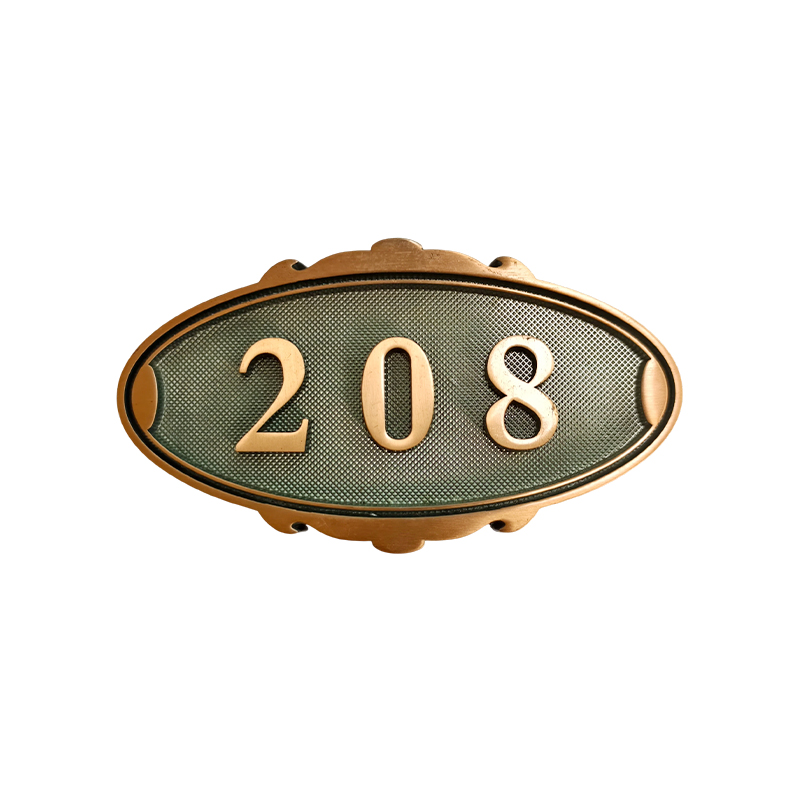
However, the significance of a house number extends far beyond practicality. On a design level, it has become a miniature carrier of urban aesthetics and regional culture. Cast-iron house numbers in historic districts incorporate traditional patterns, showcasing the weight of time; minimalist metal signs in modern communities echo architectural styles, conveying a simple elegance; and distinctive towns use terracotta, bamboo, wood, or painted forms to display local characteristics. The choice of font, color scheme, and material texture all reflect respect for the spirit of the place. A well-designed house number not only identifies a location but also speaks to the character of the place.
On an emotional level, a house number is a symbolic representation of "home." For residents, "No. XX, XX Road" is not just an address but also an anchor point for childhood memories, growth trajectory, and a sense of belonging. Years after moving, people still remember their old house numbers; in literature and film, specific house numbers are often imbued with narrative meaning—they encapsulate fragments of life, becoming objects of emotional projection. For new immigrants or tenants, hanging up a house number often signifies truly "settling down" and gaining community identity.
With the development of smart cities, house numbers are also incorporating digital elements. Some cities are piloting "QR code house numbers," allowing users to scan a code to view nearby services, report problems, or verify address authenticity; electronic house numbers support remote updates to adapt to business changes or temporary event needs. But regardless of technological evolution, its core mission remains unchanged: providing accurate, stable, and easily readable location information.
A deeper value lies in the fact that house numbers reflect the level of refinement in public governance. Scientific numbering logic (such as odd-even separation and sequential increments) reflects the rationality of urban planning; high-contrast and Braille signage friendly to people with disabilities highlight the concept of inclusion; multilingual labeling serves international communities. A small sign is, in fact, a microcosm of the city's level of civilization.
While house numbers may quietly reside in corners and above doorways, they are one of the cornerstones of a city's operation. They weave a vast spatial network with the simplest numbers; in the most unassuming form, they safeguard everyone's journey home. As night falls, a light shines behind the window of "No. 17 Happiness Lane," and the string of numbers is no longer a cold code, but a warm coordinate—because true belonging begins with a home that is clearly marked.
The core value of house numbers lies first and foremost in their functionality and standardization. A unified numbering system gives each building a unique "identity code," avoiding address confusion and greatly improving logistics efficiency and public service response speed. Firefighters can quickly locate a fire in thick smoke, couriers can accurately deliver packages, and visitors no longer get lost among similar buildings—all of this relies on clear, durable, and standardized house number signage. High-quality house numbers are made of UV-resistant, weather-resistant, and rust-resistant materials, ensuring the lettering remains clearly legible even after years of exposure to sun and rain, guaranteeing long-term information validity.
However, the significance of a house number extends far beyond practicality. On a design level, it has become a miniature carrier of urban aesthetics and regional culture. Cast-iron house numbers in historic districts incorporate traditional patterns, showcasing the weight of time; minimalist metal signs in modern communities echo architectural styles, conveying a simple elegance; and distinctive towns use terracotta, bamboo, wood, or painted forms to display local characteristics. The choice of font, color scheme, and material texture all reflect respect for the spirit of the place. A well-designed house number not only identifies a location but also speaks to the character of the place.
On an emotional level, a house number is a symbolic representation of "home." For residents, "No. XX, XX Road" is not just an address but also an anchor point for childhood memories, growth trajectory, and a sense of belonging. Years after moving, people still remember their old house numbers; in literature and film, specific house numbers are often imbued with narrative meaning—they encapsulate fragments of life, becoming objects of emotional projection. For new immigrants or tenants, hanging up a house number often signifies truly "settling down" and gaining community identity.
With the development of smart cities, house numbers are also incorporating digital elements. Some cities are piloting "QR code house numbers," allowing users to scan a code to view nearby services, report problems, or verify address authenticity; electronic house numbers support remote updates to adapt to business changes or temporary event needs. But regardless of technological evolution, its core mission remains unchanged: providing accurate, stable, and easily readable location information.
A deeper value lies in the fact that house numbers reflect the level of refinement in public governance. Scientific numbering logic (such as odd-even separation and sequential increments) reflects the rationality of urban planning; high-contrast and Braille signage friendly to people with disabilities highlight the concept of inclusion; multilingual labeling serves international communities. A small sign is, in fact, a microcosm of the city's level of civilization.
While house numbers may quietly reside in corners and above doorways, they are one of the cornerstones of a city's operation. They weave a vast spatial network with the simplest numbers; in the most unassuming form, they safeguard everyone's journey home. As night falls, a light shines behind the window of "No. 17 Happiness Lane," and the string of numbers is no longer a cold code, but a warm coordinate—because true belonging begins with a home that is clearly marked.