



How House Numbers: Silent Navigation Tools in the Urban Landscape
Release Time : 2026-01-30
In the concrete jungle of the city, with its towering buildings and crisscrossing streets, people traverse daily, rarely noticing the signs and house numbers quietly standing on corners, doorways, or lampposts. They are silent, yet provide precise directions; unassuming, they are indispensable "navigation tools" for the city's operation. From residents returning home and deliveries to emergency rescue and urban management, these seemingly small signage systems actually constitute the underlying logic of urban spatial information transmission, the silent cornerstone of the efficient operation of modern smart cities.
1. Precise Positioning: The "Nerve Endings" of the Urban Address System
House numbers are the most basic unit in the urban address coding system. Scientific, continuous, and unambiguous numbering rules give each building a unique "identity ID." When a delivery rider navigates an unfamiliar neighborhood, it is the house number that allows them to quickly locate their target among dozens of similar buildings; when an ambulance arrives, a clearly visible house number can buy precious time for saving lives. Especially in complex areas such as old residential communities and urban villages, standardized house number updates have become a key measure to improve the accessibility of public services. It can be said that although house numbers are small, they are the nerve endings of the city's geographic information system reaching the "last mile."
2. Visual Guidance: Human-centered Design Enhances Recognition Efficiency
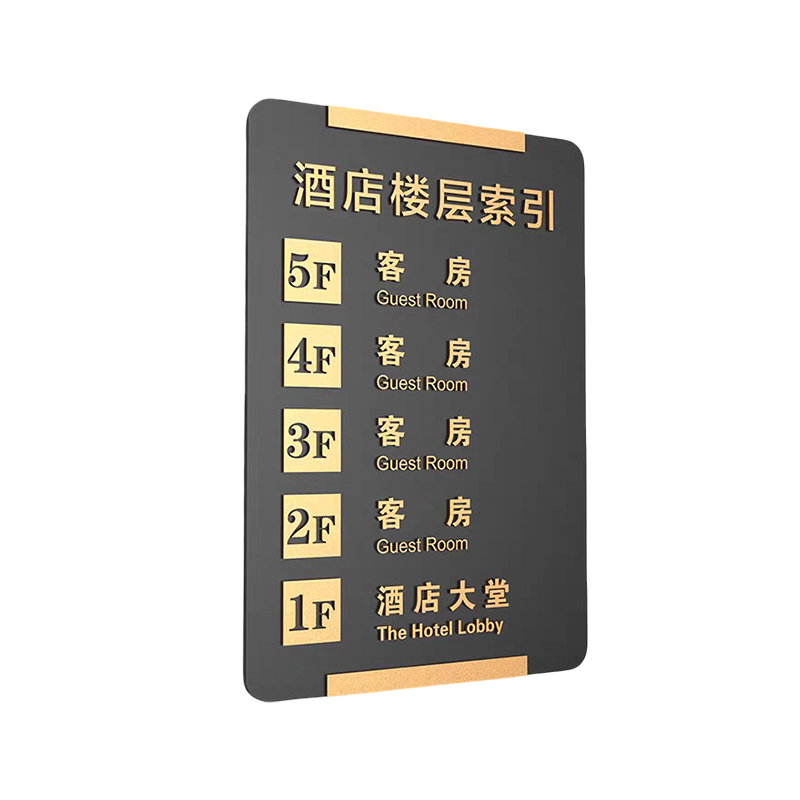
Excellent signage is not only an information carrier but also a reflection of human factors engineering. Modern city house numbers generally use high-contrast color schemes, and sans-serif fonts are used to ensure readability at long distances; the size of the numbers is calculated based on viewing distance to ensure clear identification from 5-10 meters away. Some cities have also introduced reflective film, luminous paint, or embedded LED micro-light sources to achieve nighttime visibility; Braille house numbers provide tactile navigation for visually impaired individuals. These detailed designs allow citizens of different ages and visual conditions to quickly obtain information, reflecting the city's warmth and inclusivity.
3. Cultural Expression: Showcasing Regional Characteristics in a Small Space
House numbers are not only functional symbols but also carry urban memories and cultural identity. Many historical and cultural districts retain traditional materials and calligraphic fonts, making house numbers an integral part of the streetscape. Tourist cities often incorporate local elements into their house numbers—Suzhou's garden window frames, Chengdu's panda icon, and Xiamen's ocean ripples—both providing directions and conveying the city's character. This fusion of functionality and aesthetics elevates cold, impersonal numbers into warm, personal city calling cards.
4. Smart Upgrade: From Static Signage to Dynamic Data Nodes
In the wave of digitalization, traditional house numbers are becoming increasingly intelligent. Some cities are piloting "QR code house numbers," allowing users to access nearby government services, business information, historical background, and even AR navigation by scanning the code. Other regions are linking house numbers to IoT platforms, using them as physical anchors for smart streetlights, environmental monitoring, and security surveillance. In the future, with the advancement of digital twin city construction, each house number could become a real-time updated data entry point, connecting physical spaces with virtual services and empowering refined governance.
5. Standardized Management: Unified Standards Ensure System Reliability
The effectiveness of a house number system depends on unified planning and long-term maintenance. Multiple departments, including housing and urban-rural development, civil affairs, and public security, collaborated to formulate installation standards, clarifying materials, dimensions, installation height, and update mechanisms. Regular inspections to remove obstructions, repair damage and missing numbers, and correct errors are crucial to ensuring the continued effectiveness of these "navigation wizards." The level of civilization in a city is often revealed in these meticulously attended details.
In short, signs and house numbers, though silent, are the most faithful guides in the city's network. In their simplest form, they support the order, efficiency, and humanistic care of modern society. The next time we rush past a door or a lamppost, let's pause and pay tribute to these silent "navigation wizards"—it is they that allow millions to find their way home in the vast city.
1. Precise Positioning: The "Nerve Endings" of the Urban Address System
House numbers are the most basic unit in the urban address coding system. Scientific, continuous, and unambiguous numbering rules give each building a unique "identity ID." When a delivery rider navigates an unfamiliar neighborhood, it is the house number that allows them to quickly locate their target among dozens of similar buildings; when an ambulance arrives, a clearly visible house number can buy precious time for saving lives. Especially in complex areas such as old residential communities and urban villages, standardized house number updates have become a key measure to improve the accessibility of public services. It can be said that although house numbers are small, they are the nerve endings of the city's geographic information system reaching the "last mile."
2. Visual Guidance: Human-centered Design Enhances Recognition Efficiency
Excellent signage is not only an information carrier but also a reflection of human factors engineering. Modern city house numbers generally use high-contrast color schemes, and sans-serif fonts are used to ensure readability at long distances; the size of the numbers is calculated based on viewing distance to ensure clear identification from 5-10 meters away. Some cities have also introduced reflective film, luminous paint, or embedded LED micro-light sources to achieve nighttime visibility; Braille house numbers provide tactile navigation for visually impaired individuals. These detailed designs allow citizens of different ages and visual conditions to quickly obtain information, reflecting the city's warmth and inclusivity.
3. Cultural Expression: Showcasing Regional Characteristics in a Small Space
House numbers are not only functional symbols but also carry urban memories and cultural identity. Many historical and cultural districts retain traditional materials and calligraphic fonts, making house numbers an integral part of the streetscape. Tourist cities often incorporate local elements into their house numbers—Suzhou's garden window frames, Chengdu's panda icon, and Xiamen's ocean ripples—both providing directions and conveying the city's character. This fusion of functionality and aesthetics elevates cold, impersonal numbers into warm, personal city calling cards.
4. Smart Upgrade: From Static Signage to Dynamic Data Nodes
In the wave of digitalization, traditional house numbers are becoming increasingly intelligent. Some cities are piloting "QR code house numbers," allowing users to access nearby government services, business information, historical background, and even AR navigation by scanning the code. Other regions are linking house numbers to IoT platforms, using them as physical anchors for smart streetlights, environmental monitoring, and security surveillance. In the future, with the advancement of digital twin city construction, each house number could become a real-time updated data entry point, connecting physical spaces with virtual services and empowering refined governance.
5. Standardized Management: Unified Standards Ensure System Reliability
The effectiveness of a house number system depends on unified planning and long-term maintenance. Multiple departments, including housing and urban-rural development, civil affairs, and public security, collaborated to formulate installation standards, clarifying materials, dimensions, installation height, and update mechanisms. Regular inspections to remove obstructions, repair damage and missing numbers, and correct errors are crucial to ensuring the continued effectiveness of these "navigation wizards." The level of civilization in a city is often revealed in these meticulously attended details.
In short, signs and house numbers, though silent, are the most faithful guides in the city's network. In their simplest form, they support the order, efficiency, and humanistic care of modern society. The next time we rush past a door or a lamppost, let's pause and pay tribute to these silent "navigation wizards"—it is they that allow millions to find their way home in the vast city.