
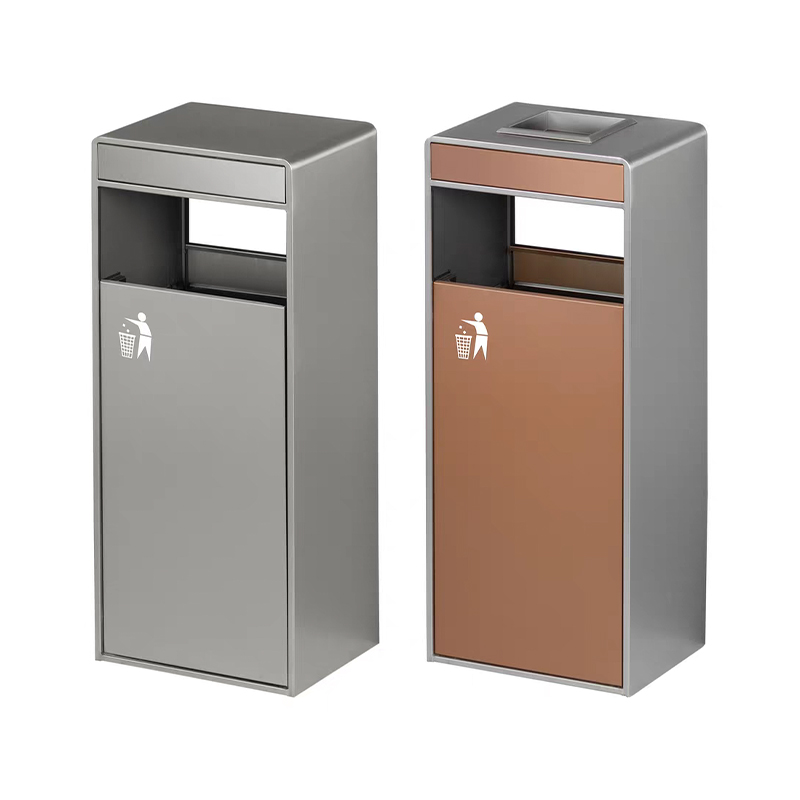




How can the signage for garbage cans accurately convey information about categorized garbage disposal?
Release Time : 2026-01-15
Garbage cans, as key carriers guiding waste sorting and disposal in urban public spaces, directly impact public sorting behavior and efficiency through the accuracy of their content. This process requires balancing clarity of information delivery, cultural adaptability, visual appeal, and multilingual coverage, achieving the goal of "easy to understand at a glance, accurate disposal with ease" through systematic design. The following seven dimensions illustrate how to improve the accuracy of waste sorting information through signage content optimization.
The core information of the signs must be highly consistent with local waste sorting standards. Different cities or regions have different waste classifications. For example, some cities use a four-category system of "recyclables, hazardous waste, kitchen waste, and other waste," while other regions may further subdivide kitchen waste into "wet waste" and "dry waste." The content of the signs must strictly adhere to the classification definitions in local policy documents, avoiding vague or confusing expressions. For example, "recyclable waste" should explicitly include specific materials such as paper, plastic, metal, and glass, rather than simply being labeled "recyclable" in general; "hazardous waste" should list common items such as batteries, light bulbs, and medicines, rather than just using the general term "dangerous goods." This precise matching can reduce mis-disposal behavior caused by unclear classification standards.
The design of graphic symbols must conform to internationally accepted standards and local cognitive habits. The International Organization for Standardization (ISO) has developed a set of universal graphic symbols for waste classification, such as three cyclic arrows representing recyclable waste and a skull and crossbones representing hazardous waste. These symbols have cross-cultural recognizability, but details need to be adjusted according to local realities. For example, the symbol for food waste is often represented internationally by apple cores and fish bones, but in areas where rice is the staple food, rice grains or vegetable leaves can be added to enhance recognition. The size and color contrast of the symbols also need to be optimized to ensure clear identification from 5 meters away, avoiding information loss due to symbols that are too small or have similar colors.
Textual descriptions should be concise and clear, avoiding technical jargon. The text on signs and labels should be limited to 10 characters or less, prioritizing everyday language over policy jargon. For example, label "other waste" as "difficult-to-recycle waste," or use "leftovers" instead of the technical terms in "perishable waste." For necessary technical terms, provide clear explanations, such as adding "waste harmful to the environment or human health" below "hazardous waste." The font, size, and layout of the text should also prioritize readability, avoiding artistic lettering or excessively small fonts to ensure easy reading for the elderly or those with poor eyesight.
Multilingual coverage is a crucial supplement to improving information accuracy. In international settings such as tourist attractions and transportation hubs, signs and labels should include commonly used foreign languages such as English and Japanese, with accurate and professional translations. For example, "recyclable materials" should be translated as "Recyclables" instead of "Reusable," and "hazardous waste" as "Hazardous Waste" instead of "Dangerous Garbage." The placement of foreign language labels should be symmetrical to the Chinese text, with consistent font sizes to avoid unclear information hierarchy due to chaotic layout. Some cities are also experimenting with labeling in minority languages or dialects to further eliminate language barriers.
Dynamic information update mechanisms ensure the timeliness of signage content. As waste sorting policies change or new waste types emerge, signs need to be updated promptly. For example, when an item is changed from "recyclable" to "other waste," a temporary label needs to be added or the old label covered to prevent mis-disposal due to information delays. Some cities use electronic screens or replaceable signs, updating classification information in real time through remote control systems. This flexibility significantly improves the accuracy of information delivery.
Scenario-based design enhances the relevance of signage. Different public spaces generate different types of waste, requiring signage content to be customized to the specific scenario. For example, garbage cans in parks can emphasize that "fallen leaves" and "dried branches" belong to kitchen waste, while garbage cans near office buildings should highlight the classification of "coffee cups" and "takeout boxes." This scenario-based design reduces the cognitive burden on the public, allowing them to quickly find the corresponding classification information in a specific environment. Some cities have also added "Commonly Misplaced Items" prompts to signs, such as labeling "milk tea cups" as "other waste" instead of "recyclable waste," further refining the classification guidance.
Public participation is a crucial step in evaluating and optimizing sign content. Questionnaires, on-site observations, or online feedback are used to collect public understanding of the sign content and suggestions for improvement. For example, if it is found that most people mistakenly dispose of "toilet paper" as recyclable waste, a specific reminder can be added to the sign stating "Toilet paper belongs to other waste." Some cities also hold "sign design competitions," inviting citizens to participate in content creation. This participatory design not only enhances the approachability of signs but also ensures they are more closely aligned with the public's actual needs. Through continuous iteration and optimization, the garbage can classification information on signs can ultimately be upgraded from "precise communication" to "proactive guidance."