



How do index cards improve information retrieval efficiency in large public places?
Release Time : 2025-12-19
In large public places such as supermarkets, airports, hospitals, and train stations, where crowds are dense and functional areas are complex, the core mission of a spatial wayfinding system is to enable visitors to accurately find their destination in the shortest possible time. Index cards—a seemingly small but highly practical wayfinding component—are becoming a key tool for improving information retrieval efficiency due to their modularity, high readability, and flexible update capabilities. They are not only an "intelligent extension" of static signs but also a bridge for efficient dialogue between people and space.
1. Structured Information Presentation: Locating the Target Area at a Glance
Large venues often contain dozens or even hundreds of functional points. Piling all the information onto a single sign can easily cause visual confusion. The index card system uses a hierarchical logic of "main sign + index card": the main sign indicates the name of the current area, and multiple rows of slotted index cards are placed below or on the side, with each card displaying only one key information point. This structured layout follows the "one information at a time" principle, significantly reducing cognitive load. Users no longer need to scan an entire wall; a quick glance at the card title is enough to locate the desired direction, reducing average search time by over 40%.
2. High Contrast and Standardized Design: Ensuring Clear Identification at Long Distances
Index cards are made of high-density PVC, acrylic, or laminated cardboard. Large, sans-serif fonts are used for printing, strictly adhering to color contrast standards to ensure clear visibility at a distance of 5-10 meters. Furthermore, card size, borders, and arrow symbols are all designed according to uniform specifications, creating visual consistency. For example, in airports, all boarding gate index cards use blue backgrounds with white lettering, while baggage claim uses green backgrounds with white lettering. Even illiterate users can quickly categorize items by color. This standardized language greatly improves information reception efficiency across cultural and age groups.
3. Flexible Insertion and Removal Mechanism: Achieving Real-Time Dynamic Information Updates
Traditional printed signs require complete replacement upon content changes, resulting in high costs and slow response times. Index cards, however, use slots or magnetic attachments. Staff simply remove the old card and insert the new one, completing the information update within 30 seconds. During supermarket promotional seasons, index cards in the fresh produce section can be updated daily with information on discounted items; in hospitals, cards for temporarily closed departments can be removed immediately; in office buildings, meeting room reservation status can be displayed in real time by flipping a double-sided card. This "plug-and-play" flexibility ensures that wayfinding information is always synchronized with the actual scenario, avoiding misleading users.
4. Multi-Scenario Adaptability: A Universal Solution from Commercial to Public Services
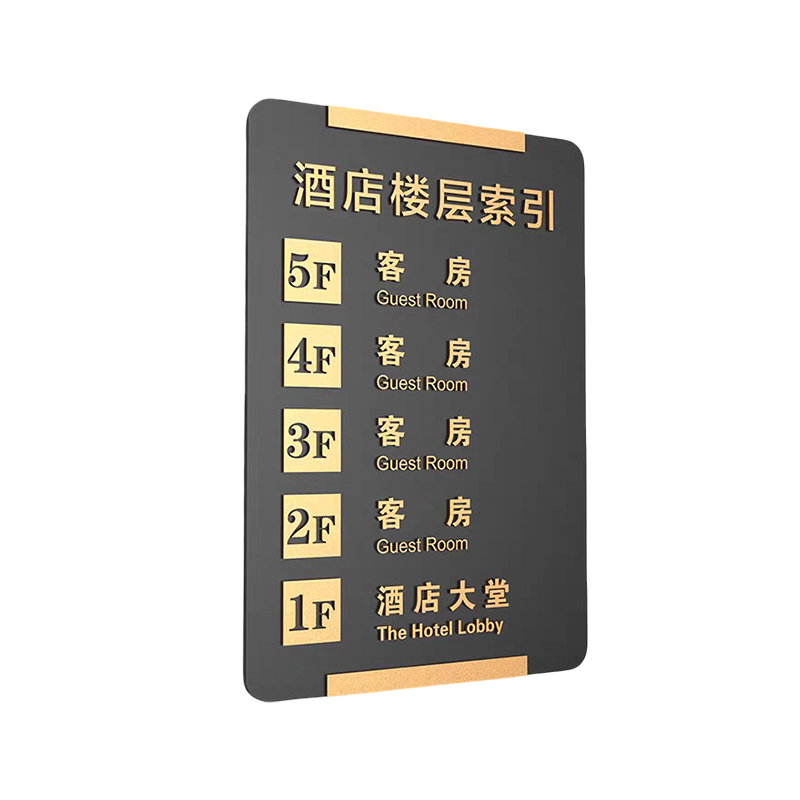
The modular nature of the index card system allows it to seamlessly integrate into various environments: supermarket shelf endcaps use them to label categories and price ranges; school corridors use class index cards to guide parents; train station halls use them to indicate ticket sales, security checks, and exit flow; hospital outpatient areas are subdivided by department, reducing repeated inquiries by patients. Some high-end systems also support bilingual or multilingual cards side-by-side, serving international audiences. Furthermore, index cards can be linked with digital screens—the card provides basic directions, and the QR code guides to an electronic map, forming a complementary "static + dynamic" smart wayfinding network.
The value of index cards lies not in flashy technology, but in "just the right amount of precision." Using the simplest physical medium to carry the most efficient wayfinding information, it creates a clear, reliable, and low-anxiety path for people in complex public spaces. When a small card helps an elderly person find the registration desk smoothly, a traveler arrive at the boarding gate on time, or a customer quickly locate their desired item, it fulfills the ultimate mission of wayfinding design—making space serve people, rather than people adapt to space. In today's pursuit of both humanization and efficiency, the index card, though small, is an indispensable "information capillary" for building a friendly city.
1. Structured Information Presentation: Locating the Target Area at a Glance
Large venues often contain dozens or even hundreds of functional points. Piling all the information onto a single sign can easily cause visual confusion. The index card system uses a hierarchical logic of "main sign + index card": the main sign indicates the name of the current area, and multiple rows of slotted index cards are placed below or on the side, with each card displaying only one key information point. This structured layout follows the "one information at a time" principle, significantly reducing cognitive load. Users no longer need to scan an entire wall; a quick glance at the card title is enough to locate the desired direction, reducing average search time by over 40%.
2. High Contrast and Standardized Design: Ensuring Clear Identification at Long Distances
Index cards are made of high-density PVC, acrylic, or laminated cardboard. Large, sans-serif fonts are used for printing, strictly adhering to color contrast standards to ensure clear visibility at a distance of 5-10 meters. Furthermore, card size, borders, and arrow symbols are all designed according to uniform specifications, creating visual consistency. For example, in airports, all boarding gate index cards use blue backgrounds with white lettering, while baggage claim uses green backgrounds with white lettering. Even illiterate users can quickly categorize items by color. This standardized language greatly improves information reception efficiency across cultural and age groups.
3. Flexible Insertion and Removal Mechanism: Achieving Real-Time Dynamic Information Updates
Traditional printed signs require complete replacement upon content changes, resulting in high costs and slow response times. Index cards, however, use slots or magnetic attachments. Staff simply remove the old card and insert the new one, completing the information update within 30 seconds. During supermarket promotional seasons, index cards in the fresh produce section can be updated daily with information on discounted items; in hospitals, cards for temporarily closed departments can be removed immediately; in office buildings, meeting room reservation status can be displayed in real time by flipping a double-sided card. This "plug-and-play" flexibility ensures that wayfinding information is always synchronized with the actual scenario, avoiding misleading users.
4. Multi-Scenario Adaptability: A Universal Solution from Commercial to Public Services
The modular nature of the index card system allows it to seamlessly integrate into various environments: supermarket shelf endcaps use them to label categories and price ranges; school corridors use class index cards to guide parents; train station halls use them to indicate ticket sales, security checks, and exit flow; hospital outpatient areas are subdivided by department, reducing repeated inquiries by patients. Some high-end systems also support bilingual or multilingual cards side-by-side, serving international audiences. Furthermore, index cards can be linked with digital screens—the card provides basic directions, and the QR code guides to an electronic map, forming a complementary "static + dynamic" smart wayfinding network.
The value of index cards lies not in flashy technology, but in "just the right amount of precision." Using the simplest physical medium to carry the most efficient wayfinding information, it creates a clear, reliable, and low-anxiety path for people in complex public spaces. When a small card helps an elderly person find the registration desk smoothly, a traveler arrive at the boarding gate on time, or a customer quickly locate their desired item, it fulfills the ultimate mission of wayfinding design—making space serve people, rather than people adapt to space. In today's pursuit of both humanization and efficiency, the index card, though small, is an indispensable "information capillary" for building a friendly city.