
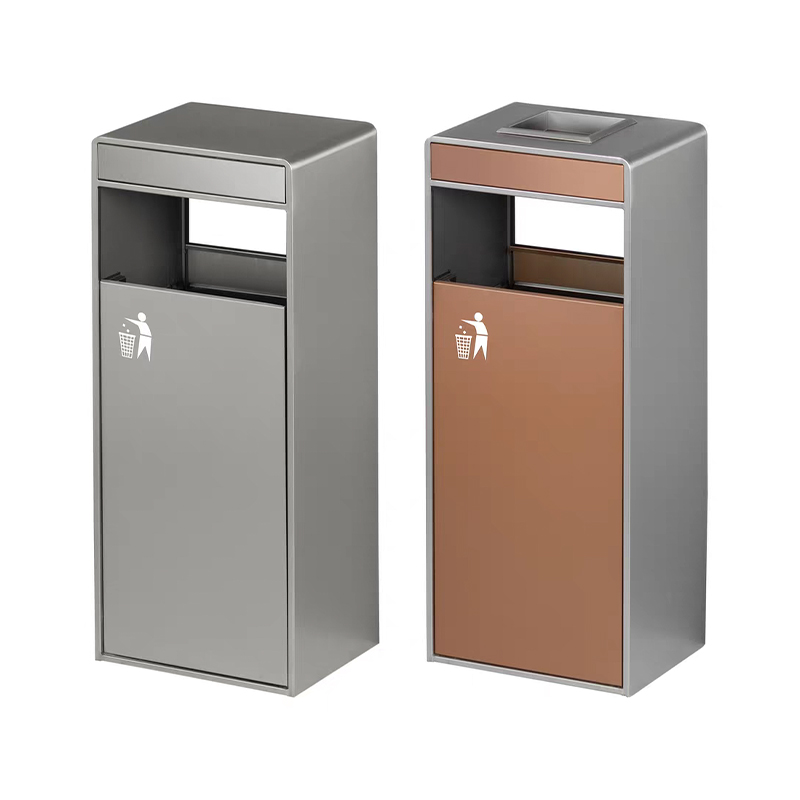





How can garbage can signs use color differentiation and graphic symbols to provide accurate sorting guidance?
Release Time : 2026-04-08
In urban public spaces and every corner of daily life, garbage cans, as the basic carriers of waste sorting, directly determine the efficiency and accuracy of waste sorting implementation through the design and placement of their signs. A scientific, intuitive, and standardized signage system, through distinct color differentiation, clear graphic symbols, and a reasonable layout, transforms complex waste sorting knowledge into easily understandable visual language. This allows citizens of different ages and cognitive levels to quickly identify and accurately dispose of waste, becoming an important bridge connecting waste sorting policies and public behavior, playing an irreplaceable role in promoting resource recycling and reducing environmental pollution.
Color differentiation is the most intuitive identifying feature of garbage can signs and the first clue guiding the public to quickly sort their waste. According to national standards and industry specifications, different types of garbage cans are assigned specific color codes: green for kitchen waste, symbolizing the natural cycle and ecological degradation of organic matter; blue for recyclables, signifying resource recycling and sustainable development; red for hazardous waste, warning of its potential harm to human health and the natural environment; and gray or black for other waste, representing remaining household waste excluding the first three categories. This color-coding system, through long-term practice and widespread promotion, has gradually become widely accepted. Citizens no longer need to carefully read the text descriptions; they can make a preliminary judgment about the function of the garbage can simply by looking at the color, significantly shortening decision-making time and improving sorting efficiency.
The precise design of graphic symbols is a core element for effective guidance in signage. The graphic symbols on the signs must strictly adhere to the national standard "Household Waste Classification Markings," using simple and clear combinations of graphics and text to intuitively display the typical characteristics and disposal range of various types of waste. The signs for kitchen waste often use fruit pits, vegetable scraps, and other food waste as prototypes, along with the words "Kitchen Waste" in both Chinese and English, clearly conveying its perishable organic nature. Recyclable waste signs mostly use a universal symbol like a circular arrow, supplemented by images of paper, plastic bottles, and aluminum cans, clearly indicating the recycling value of this type of waste. Hazardous waste signs primarily use warning symbols such as skulls and crossbones, combined with illustrations of typical items like used batteries and light bulbs, reinforcing awareness of its hazardous nature. Other waste signs are relatively simple in design, using a process of elimination to differentiate them from the previous three categories and avoid public confusion. These graphic symbols are standardized in design, possessing high recognizability and universality, allowing the public to quickly understand their meaning even across regional and cultural differences.
The standardized layout and placement of signs further enhances the practicality and convenience of waste sorting guidance. At garbage can locations, signs must be placed prominently on the front and top, ensuring that citizens can clearly identify them from a distance, avoiding mis-disposal due to obstructed vision. For modular garbage cans, all signs must be arranged in a uniform order to maintain visual neatness and consistency. For standalone garbage cans, the signs must match the color of the can body, creating a dual harmony of color and symbol. In public areas such as parks, shopping malls, and subway stations, large classification information boards must be set up at centralized garbage can disposal points, detailing the specific categories of each type of waste and disposal precautions, along with simple operation instructions to help the public resolve confusion about "how to classify." Some intelligent garbage cans also add sensor-activated voice prompts or QR code query functions next to the signs, further enhancing the accuracy of classification guidance through technological means.
From the intuitive recognition of color differentiation to the precise communication of graphic symbols, from the convenient layout design to the supplementary guidance in public areas, garbage can signage, through systematic visual design, transforms the abstract concept of waste classification into a concrete and tangible action guide. This signage system is not only a concrete manifestation of the implementation of waste classification policies but also an important tool for cultivating public environmental habits and promoting social progress. It uses silent visual language to guide everyone to practice green concepts in daily life and jointly protect the ecological environment.
Color differentiation is the most intuitive identifying feature of garbage can signs and the first clue guiding the public to quickly sort their waste. According to national standards and industry specifications, different types of garbage cans are assigned specific color codes: green for kitchen waste, symbolizing the natural cycle and ecological degradation of organic matter; blue for recyclables, signifying resource recycling and sustainable development; red for hazardous waste, warning of its potential harm to human health and the natural environment; and gray or black for other waste, representing remaining household waste excluding the first three categories. This color-coding system, through long-term practice and widespread promotion, has gradually become widely accepted. Citizens no longer need to carefully read the text descriptions; they can make a preliminary judgment about the function of the garbage can simply by looking at the color, significantly shortening decision-making time and improving sorting efficiency.
The precise design of graphic symbols is a core element for effective guidance in signage. The graphic symbols on the signs must strictly adhere to the national standard "Household Waste Classification Markings," using simple and clear combinations of graphics and text to intuitively display the typical characteristics and disposal range of various types of waste. The signs for kitchen waste often use fruit pits, vegetable scraps, and other food waste as prototypes, along with the words "Kitchen Waste" in both Chinese and English, clearly conveying its perishable organic nature. Recyclable waste signs mostly use a universal symbol like a circular arrow, supplemented by images of paper, plastic bottles, and aluminum cans, clearly indicating the recycling value of this type of waste. Hazardous waste signs primarily use warning symbols such as skulls and crossbones, combined with illustrations of typical items like used batteries and light bulbs, reinforcing awareness of its hazardous nature. Other waste signs are relatively simple in design, using a process of elimination to differentiate them from the previous three categories and avoid public confusion. These graphic symbols are standardized in design, possessing high recognizability and universality, allowing the public to quickly understand their meaning even across regional and cultural differences.
The standardized layout and placement of signs further enhances the practicality and convenience of waste sorting guidance. At garbage can locations, signs must be placed prominently on the front and top, ensuring that citizens can clearly identify them from a distance, avoiding mis-disposal due to obstructed vision. For modular garbage cans, all signs must be arranged in a uniform order to maintain visual neatness and consistency. For standalone garbage cans, the signs must match the color of the can body, creating a dual harmony of color and symbol. In public areas such as parks, shopping malls, and subway stations, large classification information boards must be set up at centralized garbage can disposal points, detailing the specific categories of each type of waste and disposal precautions, along with simple operation instructions to help the public resolve confusion about "how to classify." Some intelligent garbage cans also add sensor-activated voice prompts or QR code query functions next to the signs, further enhancing the accuracy of classification guidance through technological means.
From the intuitive recognition of color differentiation to the precise communication of graphic symbols, from the convenient layout design to the supplementary guidance in public areas, garbage can signage, through systematic visual design, transforms the abstract concept of waste classification into a concrete and tangible action guide. This signage system is not only a concrete manifestation of the implementation of waste classification policies but also an important tool for cultivating public environmental habits and promoting social progress. It uses silent visual language to guide everyone to practice green concepts in daily life and jointly protect the ecological environment.